

Tile adhesive producers juggle tight margins, variable sand and cement quality, and customers who expect large-format tiles to stay firmly in place for decades. Every raw material change can affect bond strength, open time, and slip resistance, while a failed batch can cost both money and customer trust. Viaduct Blackbox for Tile Adhesive offers a ready-to-blend additive system that helps manufacturers improve formulation consistency and simplify production. Developed by Viaduct Chemtech, Viaduct Blackbox helps reduce formulation guesswork, maintain reliable product performance, and make grey tile adhesive production faster and easier to scale. This article explores five reasons why this additive system can support more efficient and consistent manufacturing.
Key Takeaways
- A single additive package delivers bond strength, workability, and water retention together.
- A pre-engineered system shortens trial cycles and reduces batch-to-batch variation in tile adhesive formulation.
- The right tile adhesive additives control open time, slip resistance, and shrinkage without complex dosing.
- Tile adhesive solutions built around one input simplify procurement and quality control.
- Improving tile adhesive performance starts with balancing cellulose ethers, redispersible polymers, and functional modifiers.
1. One Additive Replaces Many Raw Materials
Traditional grey tile adhesive formulation means sourcing five or six modifiers, testing each one, and balancing them against local sand and cement. Viaduct Blackbox for Tile Adhesive Type 3 Grey packages those performance modifiers into one engineered additive. Formulators add a defined dosage to their base mix of cement, sand, and fillers, and the additive handles water retention, workability, and adhesion together. Teams reach a working recipe in fewer trials, which frees lab time and speeds up product launches.
2. Strong Bond Strength for Vitrified and Large-Format Tiles
Porcelain and vitrified tiles absorb almost no water, so they give a weak adhesive little to grip. Heavier, larger tiles also load every square inch of the bed. The polymer content in the additive builds a flexible, high-grip layer that bonds to both the substrate and the tile back. Tiles stay in place under foot traffic, furniture loads, and temperature swings, and dealers receive fewer complaints about hollow sounds and popped corners.
3. Reliable Workability and Open Time on Site
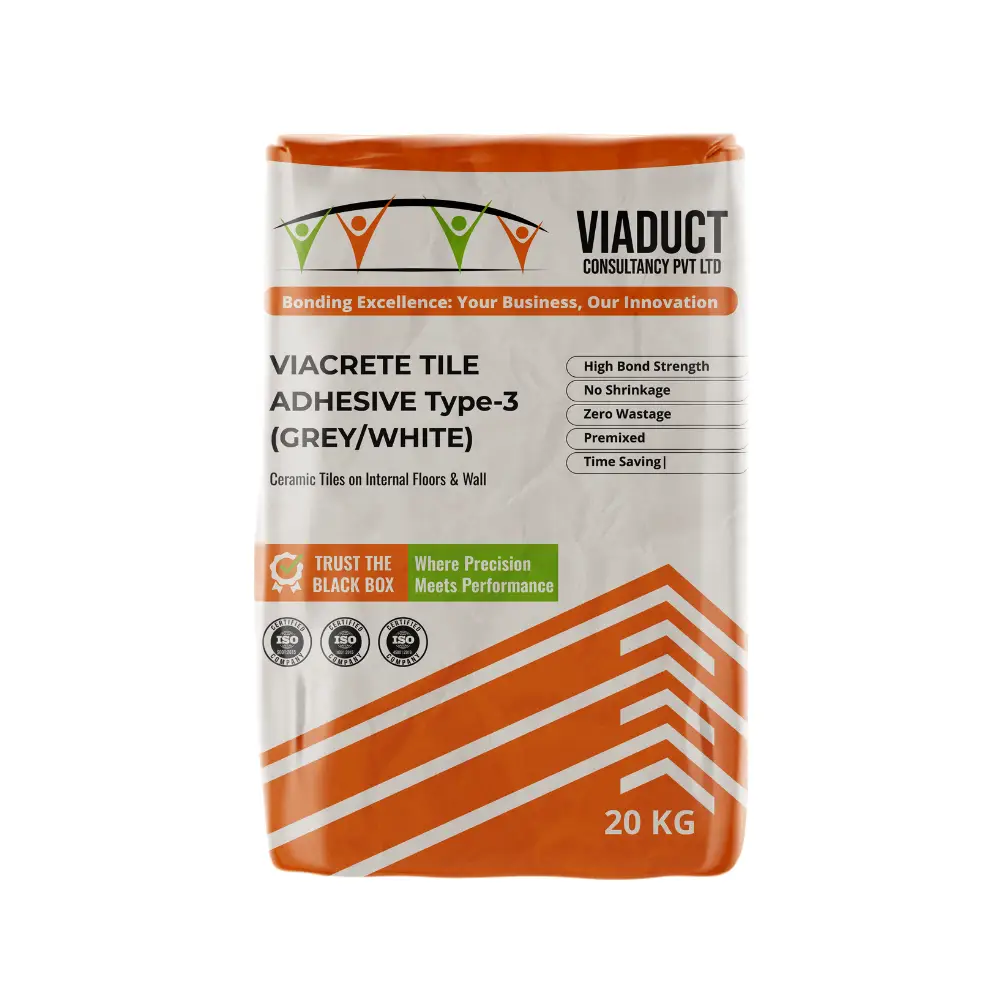
Installers judge an adhesive within minutes of opening the bag. Viaduct Blackbox for Tile Adhesive Type 3 Grey helps the mix spread smoothly, hold its trowel ridges, and stay adjustable long enough for accurate tile alignment. That open time cuts lippage and rework on large floors, and the controlled slip resistance keeps wall tiles from sliding while the adhesive cures. Contractors who experience this behavior on one job ask for the same brand on the next.
4. Consistent Batches and Tighter Quality Control
Sand fines, cement fineness, and ambient temperature all shift the results of a tile adhesive. A single controlled input removes several of those variables from the production line. Operators make fewer dosing mistakes, quality teams monitor fewer ingredients, and every batch behaves like the last one. Producers who lack a large in-house R&D team benefit most, because the validated balance inside the additive does much of the development work for them.
5. Lower Inventory Burden and Predictable Cost
Stocking multiple raw materials ties up storage space and working capital. One additive simplifies purchasing, reduces the risk of running short on a minor ingredient, and makes cost per bag easy to calculate. Viaduct Blackbox for Tile Adhesive Type 3 Grey also scales cleanly, since plants move from lab trials to full production without redesigning the recipe. Producers protect their margins and keep delivery schedules intact.
Tips for Improving Tile Adhesive Performance
Even the best additive performs better when the base mix and site practices support it:
- Control sand gradation. Clean, well-graded sand produces a denser, more workable adhesive.
- Hold the water-to-powder ratio. Too much water cuts strength, and too little hurts workability.
- Mix, rest, and remix. A short rest activates the water-retaining components fully.
- Back-butter large tiles. A thin coat on the tile back guarantees full coverage.
Take the Next Step with Viaduct Chemtech
Producers who want to refine their adhesive range can talk with the technical team at Viaduct Chemtech about dosage guidance, sample availability, and formulation support tailored to their raw materials. A short conversation often shows where one small adjustment can lift performance across an entire product line.
FAQs
1. What is Viaduct Blackbox used for?
It is an additive system that helps manufacturers develop grey tile adhesive with strong bond strength, good water retention, and reliable workability.
2. Does it suit large-format and vitrified tiles?
Yes. The polymer-modified balance gives the grip that heavy, low-absorption tiles need.
3. How does a single additive simplify tile adhesive formulation?
It replaces several separate ingredients with one engineered input, which reduces trial cycles, limits dosing errors, and keeps batches consistent.
4. Can small manufacturers use this system without an R&D team?
Yes. The pre-engineered design lets producers reach a working formula without building each component balance from scratch.
5. Does the additive help with open time and slip resistance?
Yes. It keeps the adhesive adjustable after placement and holds tiles in position on vertical surfaces.