

Masonry projects live or die by the quality of the joint. Builders working with AAC blocks, fly ash bricks, and concrete blocks need thin-bed mortars that bond fast, stay workable, and resist cracking over decades. Formulators, in turn, juggle cost pressure, raw material variability, and tight performance targets. Viaduct Chemtech developed Viaduct Blackbox to take the guesswork out of this process. This article explains how a ready-to-blend additive system simplifies block jointing mortar formulation and raises the standard of finished walls.
Key Takeaways
- Viaduct Blackbox for Block Jointing Mortar delivers consistent bond strength, workability, and water retention in a single additive package.
- A pre-engineered system shortens trial cycles and reduces batch-to-batch variation in block jointing mortar formulation.
- The right block jointing mortar additives control open time, sag resistance, and shrinkage without complex dosing.
- Block jointing mortar solutions built around a single additive simplify procurement and quality control.
- Improving block mortar performance starts with balancing cellulose ethers, redispersible polymers, and functional modifiers.
What Makes Block Jointing Mortar Hard to Formulate
Block jointing mortar sits in a thin layer, usually 2 to 4 mm, between precisely sized units. That thin bed leaves no room for error. Porous blocks such as AAC pull water out of the mortar within seconds, and if the mix loses moisture too fast, cement hydration stalls and the bond weakens. Workers also need enough open time to adjust blocks after placement, yet the mortar must gain strength quickly enough to keep the wall moving.
Formulators must therefore balance several competing properties at once:
- High water retention without making the mix sticky or hard to spread
- Strong adhesion to both smooth and porous block surfaces
- Low shrinkage to prevent hairline cracks along joints
- Consistent consistency across different sand grades and cement brands
Every raw material change can upset this balance. Sand fines, cement fineness, and ambient temperature all shift the results. Traditional trial-and-error development consumes weeks and still produces uneven outcomes in the field.
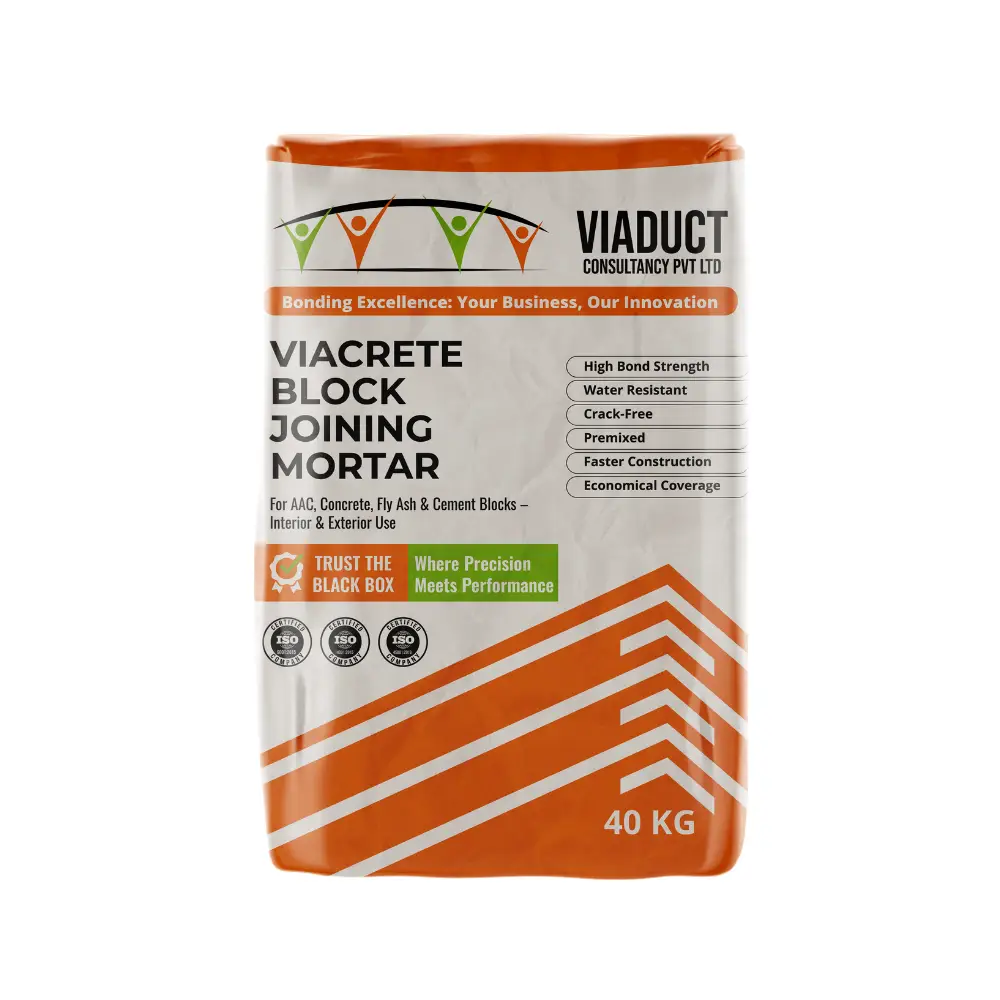
How Viaduct Blackbox for Block Jointing Mortar Simplifies Development
Viaduct Blackbox for Block Jointing Mortar packages the key performance modifiers into one engineered additive. Instead of sourcing and balancing five or six separate ingredients, formulators add a single product at a defined dosage into their base mix of cement, sand, and fillers. The additive handles water retention, workability, and adhesion together, which removes much of the iteration that slows down block jointing mortar formulation.
This approach delivers three practical advantages:
- Faster development. Teams reach a working formula in fewer trials because the additive already carries a validated balance of functional components.
- Repeatable quality. A single, controlled input reduces dosing mistakes and keeps production batches uniform.
- Easier scale-up. Plants move from lab trials to full production without redesigning the recipe.
Performance Benefits in the Field
A well-formulated mortar proves its worth on site. Masons notice the difference in how the mix spreads, how it holds on the trowel, and how the blocks settle into place.
Water retention. The additive system holds water in the mortar layer even against highly absorbent blocks. This keeps cement hydrating fully and protects bond strength at the interface.
Workability and open time. The mortar spreads smoothly and stays adjustable long enough for accurate block alignment, which cuts rework and speeds up laying.
Adhesion and cohesion. Strong bonding to the block face and internal cohesion resist the shear and tensile forces that walls experience from settlement and thermal movement.
Crack resistance. Controlled shrinkage and a flexible matrix help joints stay intact, reducing the hairline cracking that leads to plaster failure and moisture ingress.
Choosing the Right Block Jointing Mortar Additives
Not every additive suits every formulation. The best block jointing mortar additives share a few traits: they disperse easily in dry mix, perform across a range of temperatures, and stay stable during storage. Cellulose ethers regulate water retention and viscosity. Redispersible polymer powders improve adhesion and flexibility. Functional modifiers fine-tune setting behavior and sag resistance.
Viaduct Blackbox for Block Jointing Mortar combines these roles so that producers do not need to manage each ingredient separately. That integration matters most for small and mid-size manufacturers who lack extensive in-house R&D resources but still want premium product performance.
Practical Block Jointing Mortar Solutions for Manufacturers
Strong block jointing mortar solutions go beyond the additive itself. They also cover technical support, dosage guidance, and consistent supply. Manufacturers benefit when their additive supplier helps them adapt a formula to local sand, regional cement, and climate conditions.
A single-additive system supports this in several ways:
- Lower inventory burden. One product replaces multiple raw materials, which frees up storage and simplifies purchasing.
- Tighter quality control. Fewer inputs mean fewer variables to monitor on the production line.
- Cost predictability. A defined dosage makes it easier to calculate cost per bag and protect margins.
- Adaptability. Producers adjust the dosage to match different block types, including AAC, CLC, and fly ash units.
Tips for Improving Block Mortar Performance
Even the best additive performs better when the base formulation and site practices support it. Producers and contractors can improve block mortar performance by following a few proven habits:
- Control sand gradation. Well-graded, clean sand gives a denser, more workable mortar.
- Maintain the water-to-powder ratio. Too much water reduces strength, while too little hurts workability.
- Mix thoroughly. Allow the mortar to rest briefly, then remix to activate the water-retaining components fully.
- Match mortar to block. Adjust the formulation for the absorption rate of the specific block in use.
- Cure and protect joints. Shield fresh joints from direct sun and wind in hot or dry weather.
These steps reinforce what the additive already delivers and produce walls with stronger, cleaner, longer-lasting joints.
Why Viaduct Blackbox for Block Jointing Mortar Fits Modern Construction
Construction schedules keep getting tighter, and thin-bed masonry continues to replace conventional thick mortar joints because it saves material, labor, and time. Producers who want to compete in this segment need a dependable formulation base. Viaduct Blackbox for Block Jointing Mortar gives them a tested starting point that supports consistent output, easier troubleshooting, and confident product claims.
Manufacturers who adopt this system spend less time fixing inconsistencies and more time serving customers. Contractors, meanwhile, receive a mortar that behaves predictably on every job site, which builds repeat demand for the brand that supplies it.
Take the Next Step with Viaduct Chemtech
Producers exploring ways to refine their mortar range can speak with the technical team at Viaduct Chemtech to discuss dosage guidance, sample availability, and formulation support tailored to their raw materials and block types. A short conversation often reveals where a small adjustment can lift performance across an entire product line.
FAQs
1. What is Viaduct Blackbox used for?
Viaduct Blackbox is an additive system that helps manufacturers develop block jointing mortar with strong adhesion, good water retention, and reliable workability.
2. Which blocks work with block jointing mortar made using this additive?
The formulation suits AAC blocks, CLC blocks, fly ash bricks, and concrete blocks. Producers can adjust dosage to match the absorption rate of each block type.
3. How does a single additive simplify block jointing mortar formulation?
It replaces several separate ingredients with one engineered input, which reduces trial cycles, limits dosing errors, and keeps batches consistent.
4. Does the additive help with crack resistance?
Yes. Controlled shrinkage and improved cohesion help joints stay intact under thermal movement and minor settlement.
5. Can small manufacturers use this system without a large R&D team?
Yes. The pre-engineered design lets producers reach a working formula quickly without developing each component balance from scratch.
6. What factors affect final mortar performance besides the additive?
Sand gradation, cement quality, water-to-powder ratio, mixing practice, and site curing all influence the result.
7. Where can I get dosage guidance and samples?
The technical team at Viaduct Chemtech provides dosage recommendations and sample support based on your raw materials and target applications.